Hieronymus Bosch’s The Garden of Earthly Delights has inspired just about every theory imaginable. People have called it a celebration of sexual freedom, a coded heresy, a proto-surreal dream, even the product of some medieval psychedelic episode.
I do not think it is any of those things.
I think this is, quite simply, a profoundly Christian painting. It is a painting about sin, temptation, moral collapse, and punishment. Not a rejection of religious thinking, but an expression of it. And once that clicks, Bosch’s bewildering triptych begins to make a great deal more sense.
That does not make it less strange. If anything, it makes it stranger, because Bosch seems to believe every bizarre warning he paints. His monsters, hybrid creatures, swollen fruit, transparent globes, musical torture devices, and burning cities are not whimsical inventions detached from belief. They belong to a late medieval world intensely preoccupied with salvation, lust, the devil, hell, and the fragility of the human soul.
The Garden of Earthly Delights is difficult because it was meant to be difficult. It is a puzzle. It is theatrical. It is loaded with visual riddles. And I suspect it was designed to stimulate exactly the kind of anxious, clever, morally charged conversation that still surrounds it now.
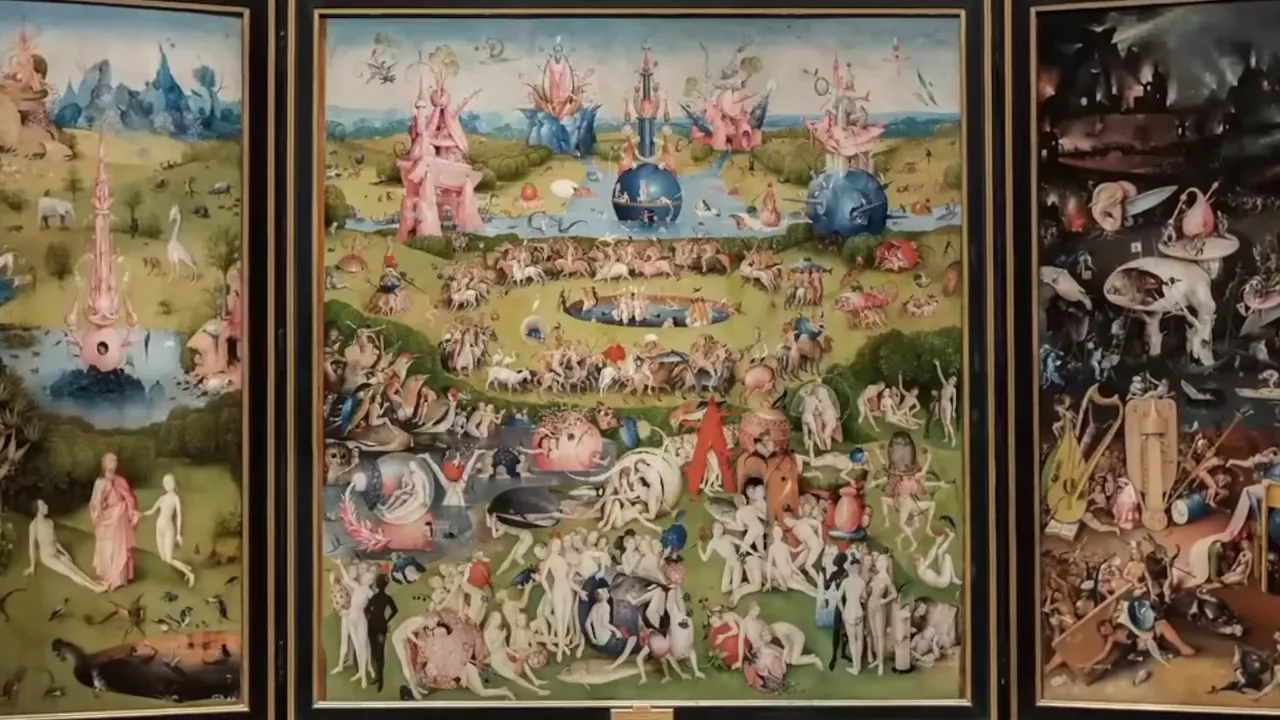
Table of Contents
- A triptych designed to unfold a story
- Bosch was not medieval in the simple sense
- The world Bosch lived in
- Who was Hieronymus Bosch?
- Where Bosch got his monsters
- The influence of hell literature
- Who may have commissioned The Garden of Earthly Delights?
- The closed wings: creation before corruption
- The left panel: Eden is already unstable
- The center panel: the paradise of pleasure
- The right panel: hell as the consequence of pleasure
- Why Bosch can look surreal but is not surrealist
- How the painting was received and why it survived
- So what does The Garden of Earthly Delights mean?
- Further context for reading Bosch
- FAQ
A triptych designed to unfold a story
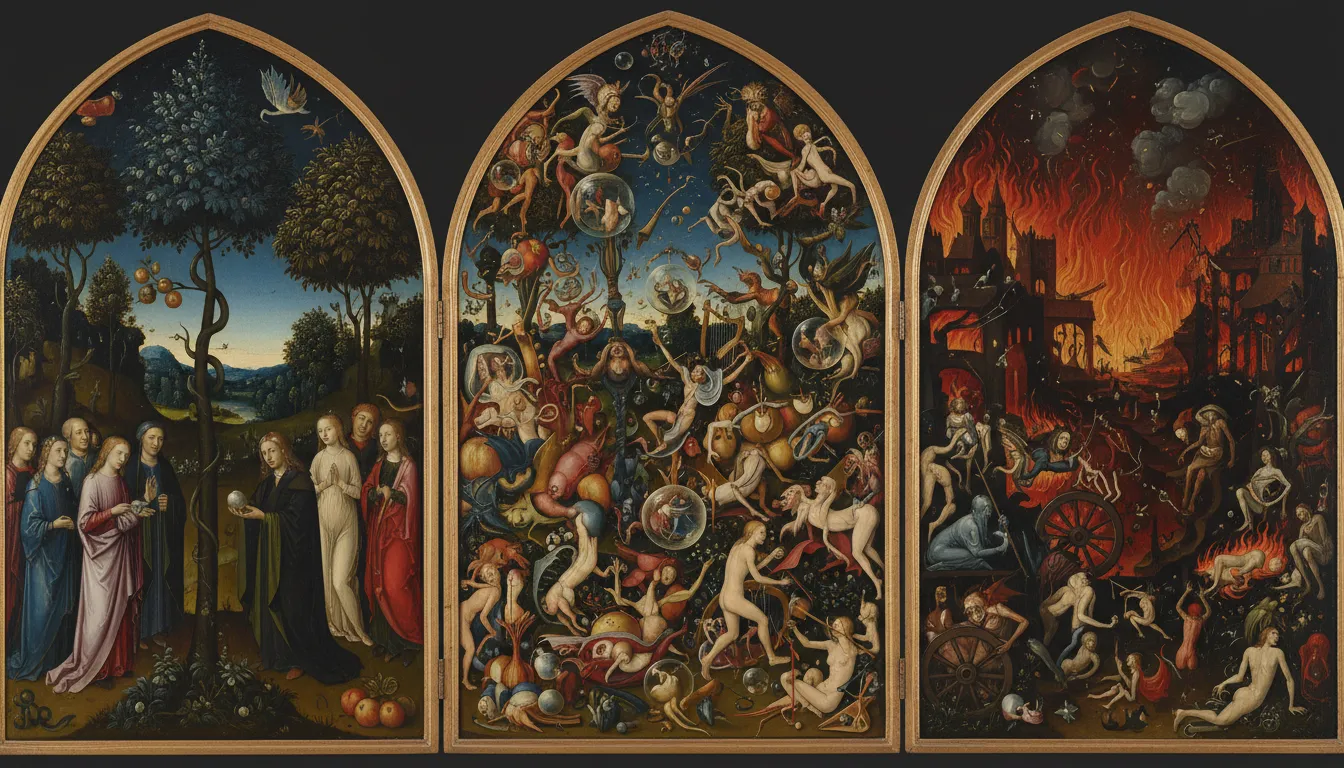
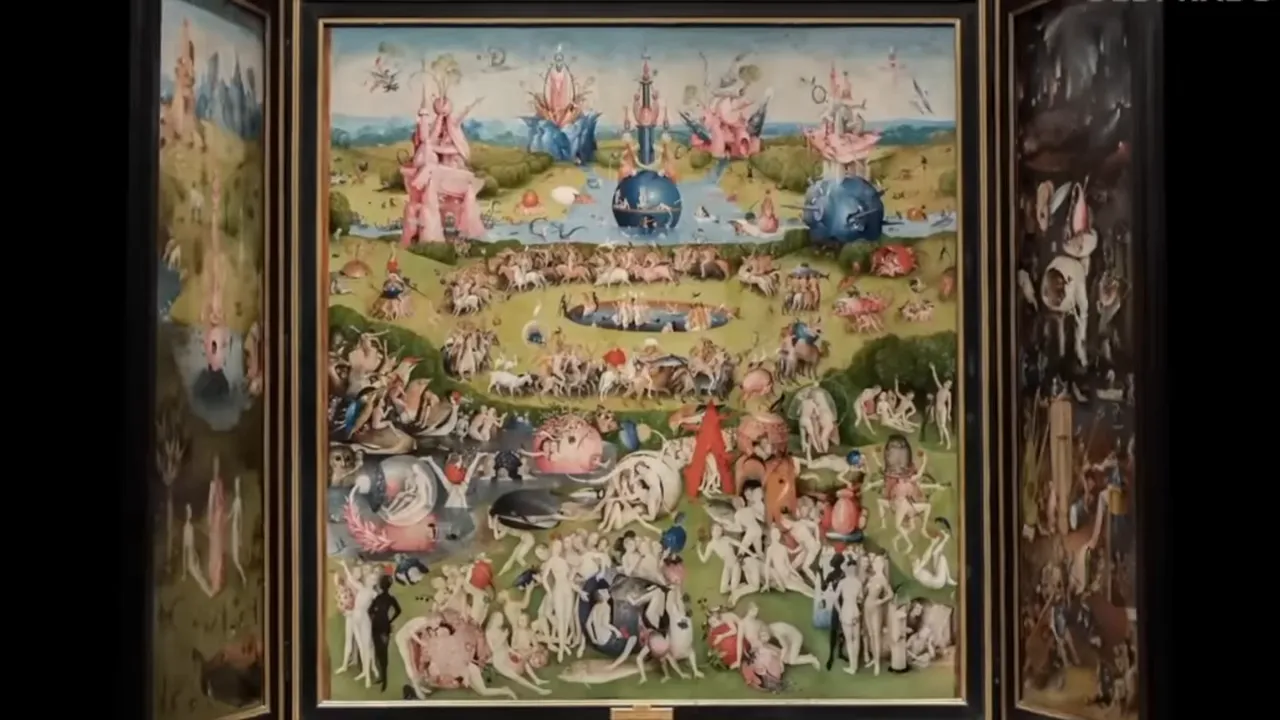
The painting consists of three oak panels hinged together. The center panel is large, with two side wings. When closed, the work presents a subdued monochrome scene of creation. When opened, it erupts into color and complexity.
That matters, because Bosch is using the very structure of the triptych to shape meaning.
Traditional triptychs often place the key sacred event in the middle, with saints or donors at either side. Bosch does something different. All three inner panels belong to the same story. They are not separate illustrations but stages in a moral sequence:
- Left panel: Eden and the joining of Adam and Eve
- Center panel: humanity surrendering to pleasure and lust
- Right panel: hell and punishment
At first glance, the work can seem anarchic, as though Bosch simply poured out image after image without order. But the composition is more disciplined than it appears. The panels are tied together by a common horizon line. Each divides into foreground, middle ground, and background. Each includes water in the middle ground. Each develops vertical structures in the distance. Repeated poses and motifs create echoes across the triptych, making the eye move from one panel to another as though following a chain of cause and effect.
Even the much-discussed apparent rejection of perspective may be overstated. Bosch does not use perspective in the polished Italian Renaissance manner, but he is hardly careless. The painting is meticulously organized.
Bosch was not medieval in the simple sense
It is common to think of Bosch as a medieval artist. He is not, at least not in the simplistic way that phrase is often used. Bosch was a Renaissance artist, an exact contemporary of Leonardo da Vinci, though he belonged to the Northern Renaissance rather than the Italian one.
That distinction is important. The Northern Renaissance did not look like Florence. Its artists often prized minute detail, layered symbolism, and moral intensity over the classical balance and anatomical idealization associated with Italy. Bosch shares the Renaissance appetite for curiosity, observation, and invention, but he applies it to theology, morality, and the bizarre edge of human imagination.
His paint handling also sets him apart. Earlier Netherlandish masters such as Jan van Eyck perfected oil painting through luminous glazes and microscopic detail, often suppressing visible brushwork. Bosch can be looser and more tactile. He allows texture, relief, and the trace of the hand to remain. There is a sketchier energy to his surfaces, and that energy suits the instability of his subject matter.
The world Bosch lived in
To understand this painting, it helps to remember the world that produced it.
Europe around 1500 was in transition. Explorers were opening up new geographies. Humanist thinkers were re-examining old assumptions. Scientific ideas were stirring. At the same time, Christian Europe was gripped by fear, conflict, orthodoxy, heresy hunts, and the looming spiritual fracture that would become the Reformation.
This was also an age in which hell was vividly imagined. Theologians, poets, preachers, and artists developed increasingly elaborate visions of punishment. The devil took on an active presence in the religious imagination. Reports of demons, witchcraft, and diabolical assault proliferated. The punishment of sin was not abstract. It was pictured, described, and feared in concrete terms.
Modern attitudes toward sexuality can badly distort how this painting is read. In Bosch’s world, sex was entangled with theological anxiety. It was not merely a natural human fact. It was tied to the Fall, to temptation, to reproduction, to marriage, and very often to transgression.
So when Bosch fills his central panel with naked bodies, fruit, birds, riders, bathers, and erotic suggestion, the point is not liberation. The point is danger.
Who was Hieronymus Bosch?
We know surprisingly little about Bosch’s life, especially compared with major Italian Renaissance figures. His real name was Jheronimus van Aken, probably born around 1450 in ’s-Hertogenbosch, commonly called Den Bosch, in the present-day Netherlands.
He came from a family of artists and later adopted the name “Bosch” from his town. He was successful, respected, and well connected, not some isolated mad genius scribbling monsters in a corner.
As a child, he likely experienced a catastrophic fire that devastated Den Bosch. It is tempting, and not unreasonable, to think that such an event left its mark on his terrifying depictions of fire and destruction.
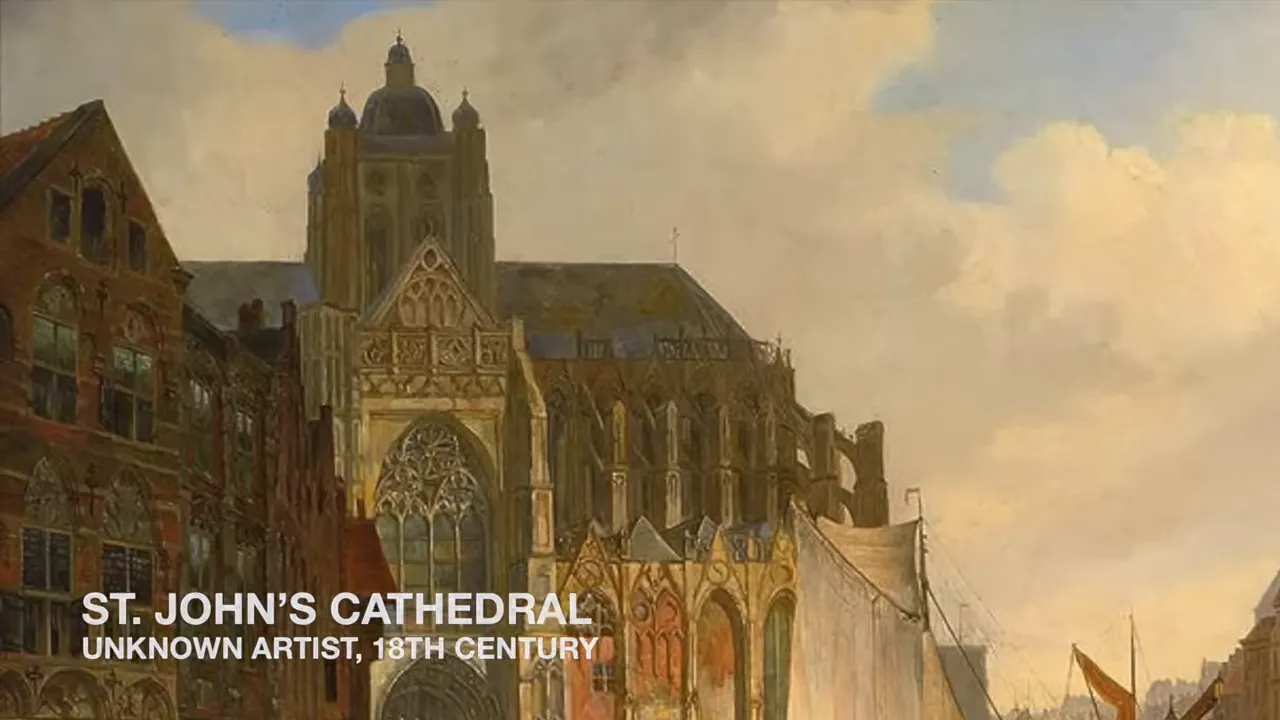
Den Bosch itself was intensely Catholic, full of churches, chapels, monasteries, and dominated by the great Gothic Cathedral of St. John. Bosch belonged to the Illustrious Brotherhood of Our Blessed Lady, a conservative religious confraternity devoted to the Virgin Mary. This was not a fringe cult. It was an elite and influential religious network. Bosch received commissions from it and moved within its inner circles.
That fact alone should make us cautious about reading him as a straightforward rebel or anti-church satirist.
Where Bosch got his monsters
Bosch’s creatures can seem unprecedented, but many of their roots are perfectly recognizable within the visual culture around him.
St. John’s Cathedral in Den Bosch was full of gothic gargoyles, strange carved beasts, and curious hybrid forms. Medieval manuscripts contained drolleries and grotesques in their margins, often comic, sexual, or absurd. Bestiaries presented real and imaginary animals not for zoological study, but for moral instruction. Travel literature introduced Europeans to exotic creatures and faraway lands that already strained the limits of imagination.
Bosch was absorbing all of this.
He also reused motifs. Like many busy painters, he maintained a bank of forms and ideas that reappear across multiple works. So even when a creature looks wildly inventive, it often belongs to a larger visual tradition and a very practical artistic process.
The influence of hell literature
Bosch’s infernal imagery did not appear in a vacuum either. Medieval Europe had a rich tradition of visionary literature describing the afterlife. Dante’s Divine Comedy is the most famous example, but there were earlier texts too, including The Vision of Tundale, that helped shape the European imagination of hell.
By Bosch’s time, heaven and hell were not vague possibilities. They were experienced as moral certainties. Art gave them form. Bosch’s right panel belongs to that world of infernal visualization, even if its details are uniquely his own.
Who may have commissioned The Garden of Earthly Delights?
The probable patron was Henry III of Nassau. By 1517, a year after Bosch’s death, the painting is documented in Henry’s palace in Brussels. Henry was a cultivated aristocrat building a sophisticated Renaissance court, and he had the taste and intelligence to appreciate a challenging allegorical work.
This matters because The Garden of Earthly Delights was probably not made as a church altarpiece. It likely belonged in a courtly setting, among other objects of wonder. Its dramatic opening and strange contents make perfect sense in an aristocratic environment where learned conversation, symbolism, and spectacle were prized.
In that context, the painting becomes not only a moral warning but a conversation piece in the fullest Renaissance sense. Its figures point, whisper, gesture, and seem to model interpretation from within the image itself.
The closed wings: creation before corruption
When shut, the triptych shows the world at creation in grisaille, a restrained monochrome often used on the outside of altarpieces. God appears small and luminous above the globe-like world, speaking creation into existence. The scene likely represents the third day of creation, when land is separated from water and vegetation appears, but before human beings have entered the world.
The world is enclosed in a transparent sphere or dome. This seems odd now, but it reflects medieval theological and artistic conventions linked to readings of Genesis and the Latin Vulgate Bible. The concept of a firmament or solid dome over creation was familiar, even if later scientific developments would render it problematic.
The closed exterior functions as a prologue. Creation exists, but humanity has not yet had the chance to misuse it.
The left panel: Eden is already unstable
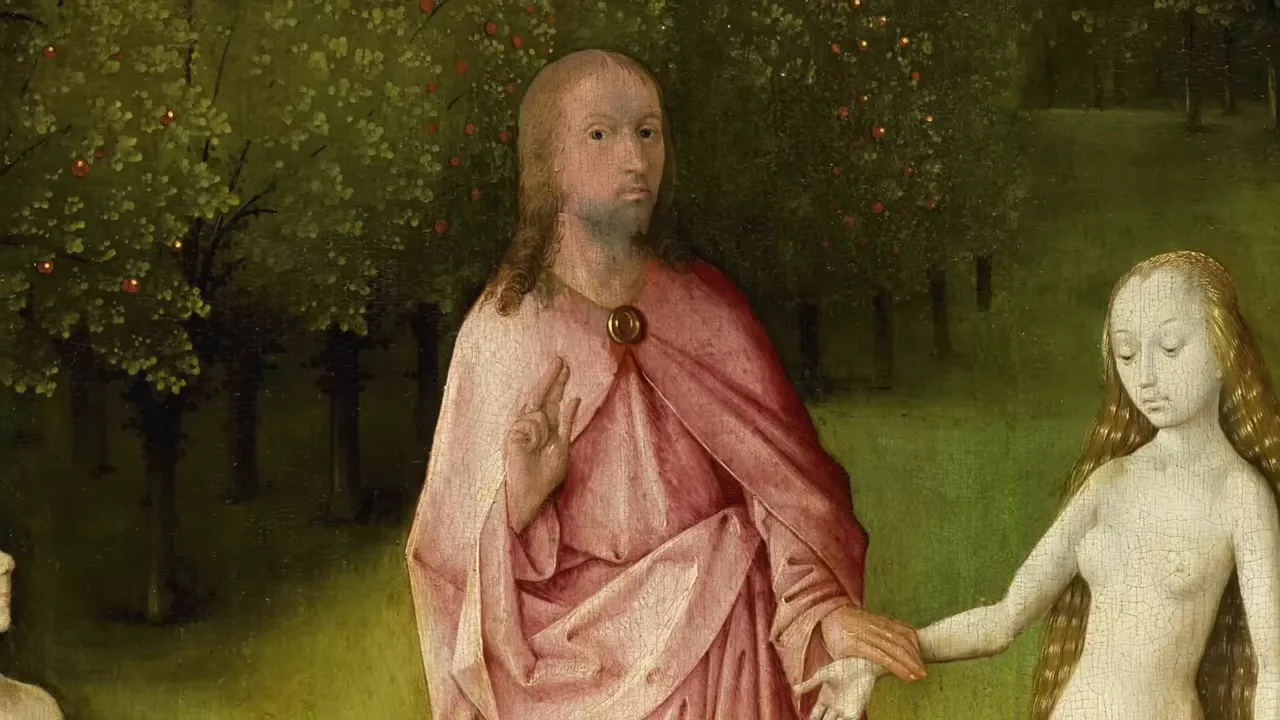
The left wing is often called the joining of Adam and Eve. Bosch does not paint the standard moment of Eve being drawn from Adam’s rib. Instead, he shows God presenting Eve to Adam and blessing their union.
This is crucial. By shifting the scene from creation to union, Bosch highlights marriage, sexuality, and procreation. God’s command to “be fruitful and multiply” hangs over the entire triptych. The central panel will then become a corruption of that command.
God here appears in a Christ-like form with fair hair and human features. This was not unusual in Bosch’s context and reflects the theological identification of Christ with God incarnate. It also introduces the idea that the Fall is already linked to redemption and crucifixion.
The symbolism in the panel is dense:
- Adam gazes at Eve with awakened desire
- Eve stands modestly but also presents herself physically
- Rabbits symbolize fertility
- A predatory cat with prey suggests violence already entering creation
- The tree of life and Eucharistic references foreshadow Christ’s sacrifice
- The serpent waits in the date palm near the tree of knowledge
Nothing here is entirely innocent. Eden looks peaceful, but evil is already latent within it.
The fountain in paradise is aligned with God and suggests divine life, baptism, and fertility. Yet an owl sits inside it. For modern eyes, an owl can suggest wisdom. In Bosch’s world, it often signals darkness, predation, or diabolical presence. Evil, in other words, is already watching.
Elsewhere, reptiles and amphibious creatures creep ashore. A rock formation resembles a face or skull, recalling Golgotha, the place of Christ’s crucifixion, and the medieval belief that Adam’s skull lay beneath it. Bosch turns paradise into a place already haunted by the consequences of original sin.
The center panel: the paradise of pleasure
The central panel is the one that has generated the wildest speculation, and it is also the panel most often misread.
This is not a utopia. It is not a simple celebration of bodily joy. It is a world in which humanity has surrendered itself to pleasure detached from God. It is Bosch’s imagined scene of mankind giving itself over to temptation. That very invention is striking, because Genesis never describes such a populated Eden. Bosch is creating a theological fiction in order to explore what happens when desire is unleashed.
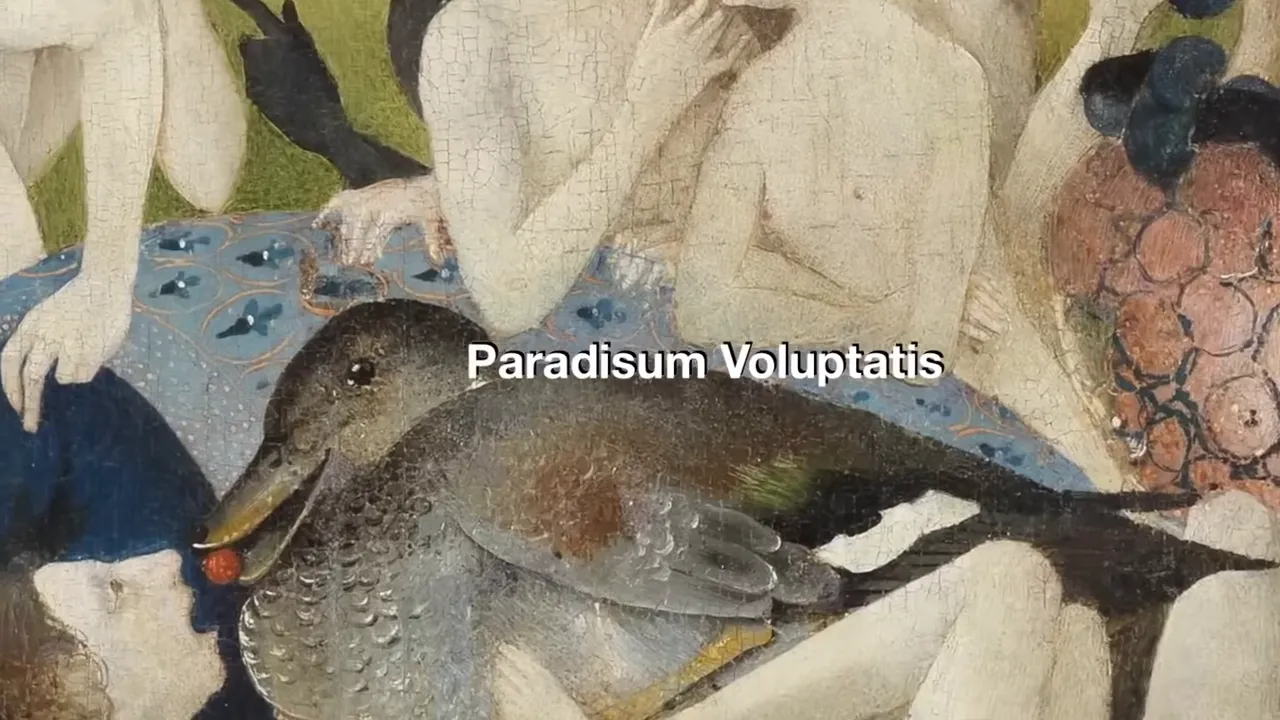
In the Vulgate tradition, Eden could be described as paradisum voluptatis, a paradise of pleasure. Bosch seizes that phrase and twists it into a warning.
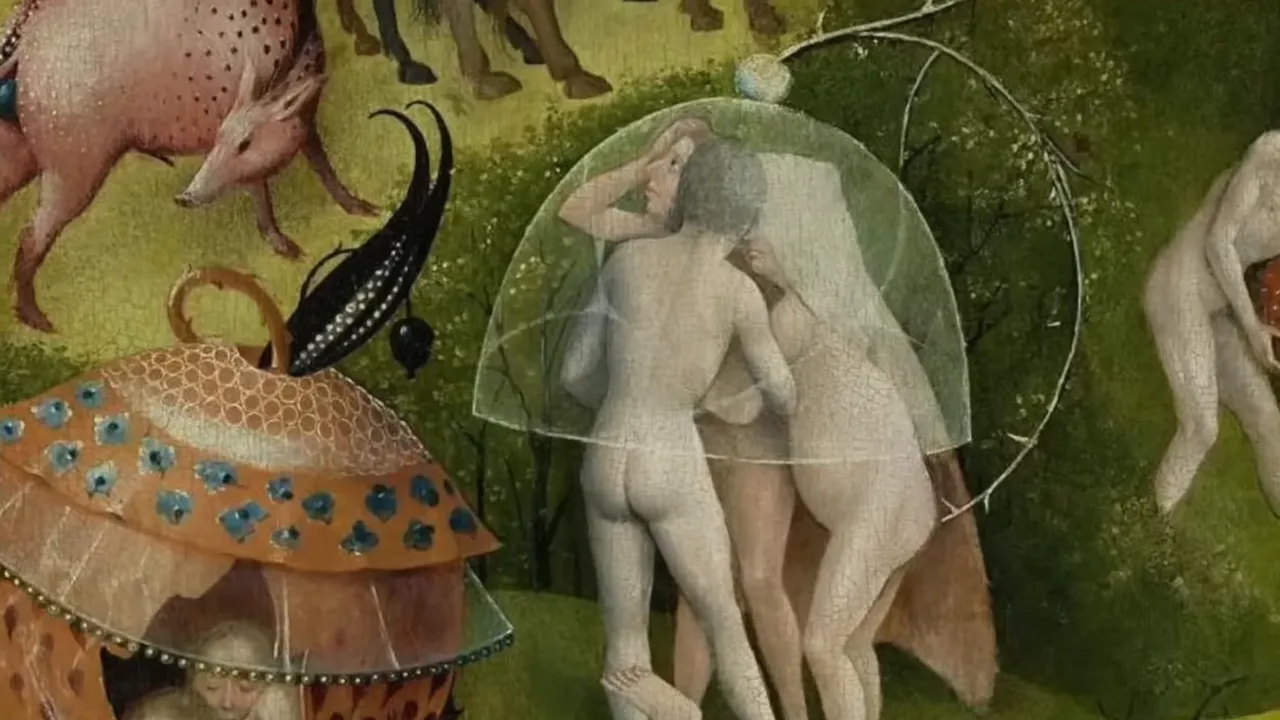
The panel is saturated with sexual symbolism. Fruit, birds, openings, shells, transparent globes, flowers, and fountains all carry erotic overtones in late medieval visual culture. In Dutch, even the language of fruit-picking and birds could carry sexual double meanings.
Everything in this world is pleasurable and fragile. Soft fruits bruise. Glass cracks. Pleasure is transient.
Why there is so much nudity
The naked figures are not naked because Bosch is imagining a free-love paradise. Their nudity reflects the state of Adam and Eve before shame, but in the central panel that innocence has been corrupted. The bodies are on display, but explicit sexual acts are largely withheld. Bosch suggests lust through implication, gesture, association, and repetition.
The effect is more unsettling than straightforward eroticism. Humanity is absorbed in sensation, appetite, pairing, circling, feeding, touching, and displaying itself. There is no work, no worship, no structure, no transcendence.
Adam and Eve in the bottom corner
One of the most revealing details may be in the lower right corner, where Bosch appears to include Adam and Eve after the Fall. Adam points toward Eve as if blaming her. Eve holds fruit. Both wear animal skins, unlike the naked masses around them. They alone seem aware of shame and moral consequence.
That corner acts almost like a key to the whole panel. This is where the chain began. Temptation has led to lust, and lust to a world of disorder.
Corruption everywhere
The center fountain is a broken version of the fountain from paradise. It still echoes Eden, but now it is brittle, pierced with thorns and spikes. In a dark opening within it, Bosch includes one of the panel’s clearest sexual scenes. The owl that occupied the earlier fountain has vanished. Lust has entered openly.
Fish appear out of water. Strange glass contraptions suggest alchemical vessels, forbidden knowledge, and meddling with dangerous processes. “Wild” men and women and interracial pairings reflect medieval prejudices and fantasies about the uncivilized other, often associated with uncontrolled sexuality.
In one strange orange enclosure, male figures turn their buttocks toward one another, a visual reference to homosexuality that Bosch’s contemporaries would have understood as sinful. Bosch is not neutral here. He is cataloging forms of non-reproductive desire through the moral lens of his time.
Again, this is not modern sexual politics. It is late medieval Christian moralism.
The great circular procession
At the center of the panel is the famous ring of men riding animals around a pool of women bathers. The animals include creatures first seen peacefully in Eden, now corrupted into mounts of lust. The riders circle endlessly, an image of restless appetite. The women in the pool evoke Venus and courtly love imagery, but not in a flattering way. Pagan beauty and sexual attraction become objects of moral suspicion.
This scene may draw on aristocratic games, fertility rituals, and visual traditions in which sins ride animals. Bosch had a long-standing preoccupation with the deadly sins, and the circularity of the procession suggests a closed system of desire that goes nowhere.
No one here is fulfilled. They are merely occupied.
The right panel: hell as the consequence of pleasure
The right wing is hell, and it is one of the most memorable infernal landscapes in Western art.
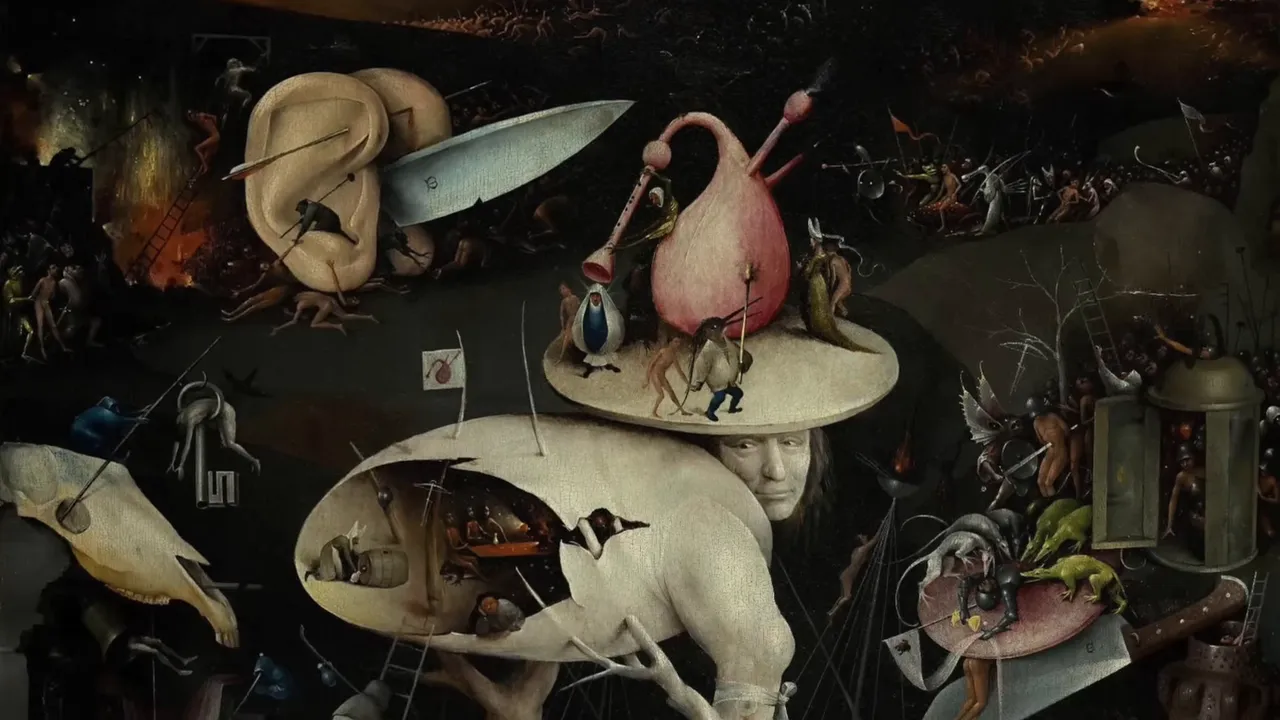
Notice first how different it is from the other panels. Eden and the pleasure garden are organic worlds. Hell is man-made. Buildings burn. weapons crush. instruments torture. Tables overturn. Gambling gear, musical devices, tavern imagery, and legal documents all become tools of punishment.
The souls are naked and ashamed. The demons are clothed. Erotic energy has drained away and become humiliation, pain, and degradation. Bosch paints monsters with the same matter-of-fact realism as the humans, which is part of what makes the scene so disturbing. He is not presenting fantasy as fantasy. He is painting punishment as an extension of reality.
The pig in a nun’s veil
In one unforgettable scene, a pig dressed as a nun attempts to persuade a man to sign a document while a demon readies pen and ink. This is sometimes read as a direct critique of church indulgences. I am not convinced. Bosch was deeply embedded in religious orthodoxy and in circles that benefited from indulgence culture.
A more plausible reading is that this is a soul being tricked into signing a pact with the devil. The anxiety around diabolical bargains was widespread in the late Middle Ages. The scene is legalistic, fraudulent, and infernal all at once.
The seven deadly sins in hell
Lust spills into other vices, and Bosch fills hell with moral consequences:
- A miser excretes gold into a cesspit
- A glutton vomits endlessly
- A slothful figure is harassed in bed by a demon
- A vain woman is forced toward her own reflection
- Gamblers lose everything at corrupted tables
- Prostitution, drunkenness, and cheating all reappear as punishable conditions
These are not random tortures. They are tailored punishments, often turning vice back onto itself. That is one of Bosch’s consistent infernal strategies.
The Prince of Hell
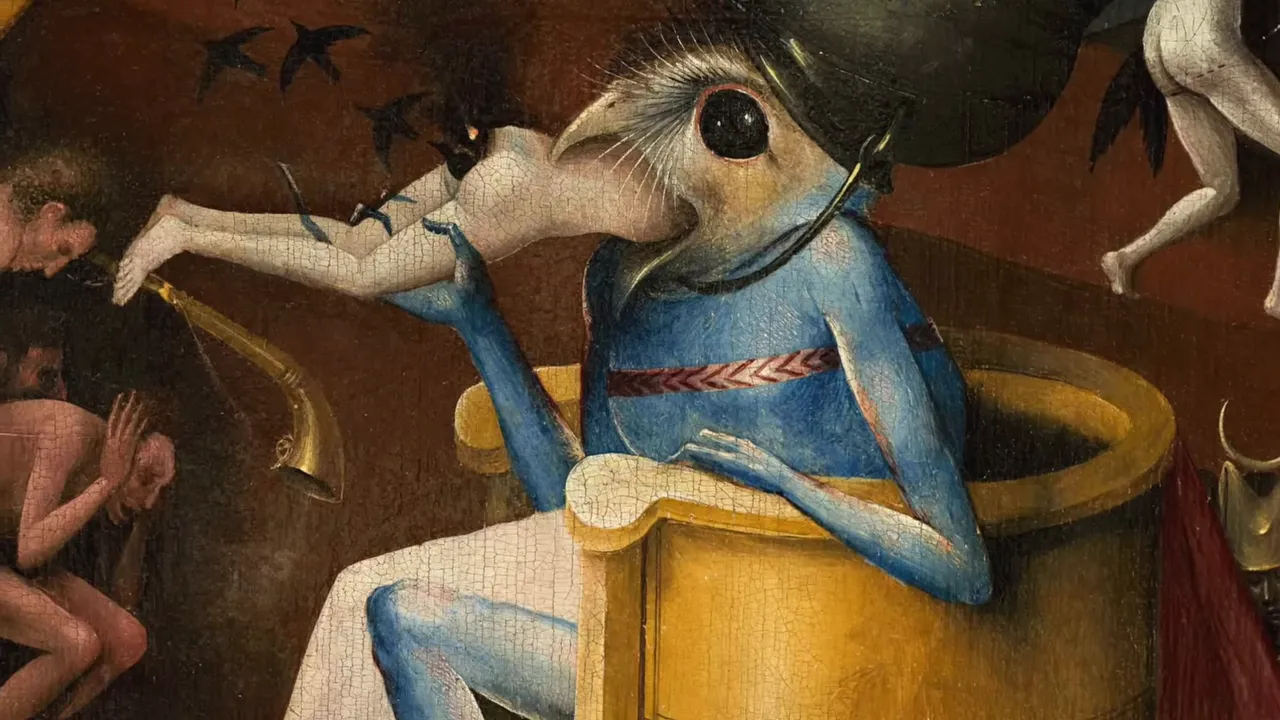
The owl returns in a far more sinister form as the Prince of Hell, enthroned on a giant chamber pot, devouring human bodies and excreting them into filth below. It is grotesque, obscene, and perfectly coherent within Bosch’s symbolism. The predator from Eden now reigns openly.
The imagery of sewers and waste would have felt particularly immediate in Bosch’s own urban environment, where foul-smelling waterways and open filth were everyday realities.
Music as torture
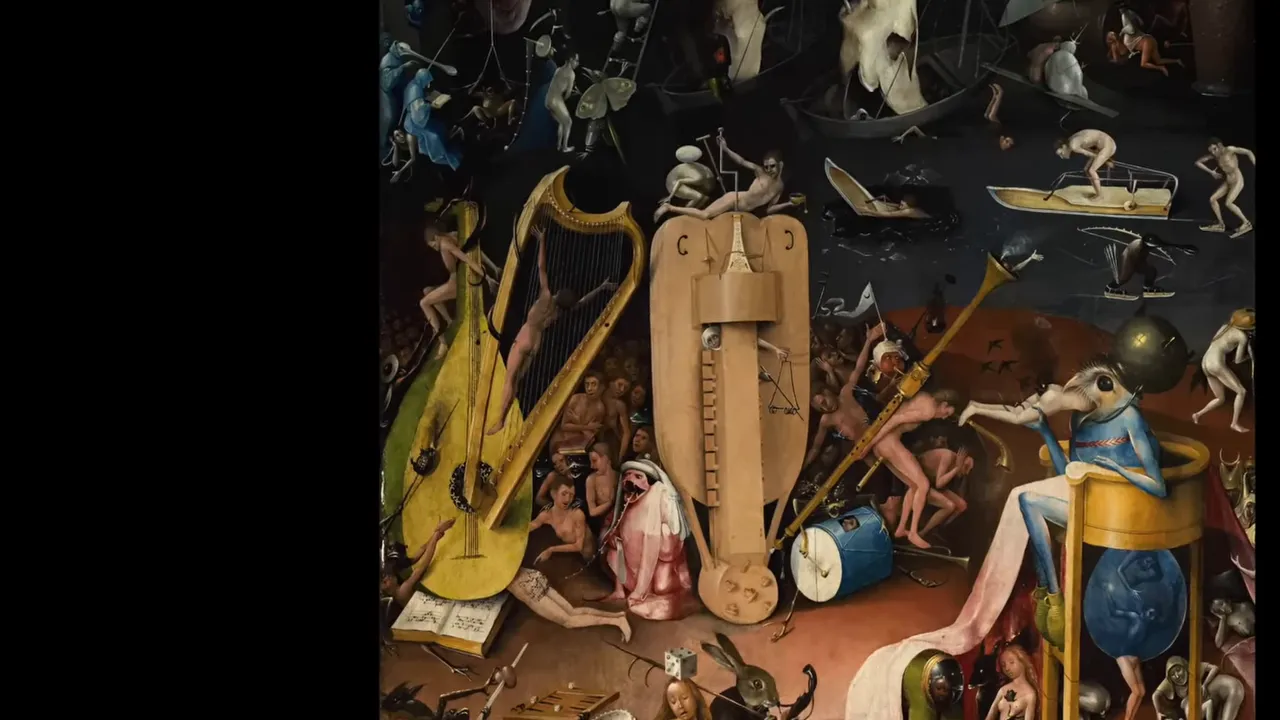
One of the most striking aspects of Bosch’s hell is the “musical hell” section. Non-religious music in Bosch’s culture could be linked to sensuality and fleshly excess, and so instruments become engines of suffering.
Lutes, harps, flutes, drums, and hurdy-gurdies crush, impale, bind, and mock the damned. A choir is forced to sing. Musical notation appears on flesh. A recorder is inserted where no recorder should ever be inserted. A giant harp becomes a parody of crucifixion.
This is hell as inversion. Human pleasures have become mechanisms of torment. Art itself, when severed from God, turns punitive.
The Tree-Man
The most famous figure in the right panel is the Tree-Man, a bizarre composite of body, broken egg, tavern, branches, boats, and bagpipes. The face is often thought to be a self-portrait of Bosch, and it does have an uncanny psychological presence.
The torso is a cracked egg, one more symbol of emptiness and spiritual hollowness. The interior resembles a tavern, a site of sin and temptation. Bagpipes crown the head, and in Bosch’s symbolic world bagpipes are associated with lust. The figure stands on decaying branch-legs balanced on boats or skiffs, suggesting the ferrying of souls.
Everything about the Tree-Man is unstable, decayed, and morally compromised. He feels less like a single monster than a whole system of corruption made flesh.
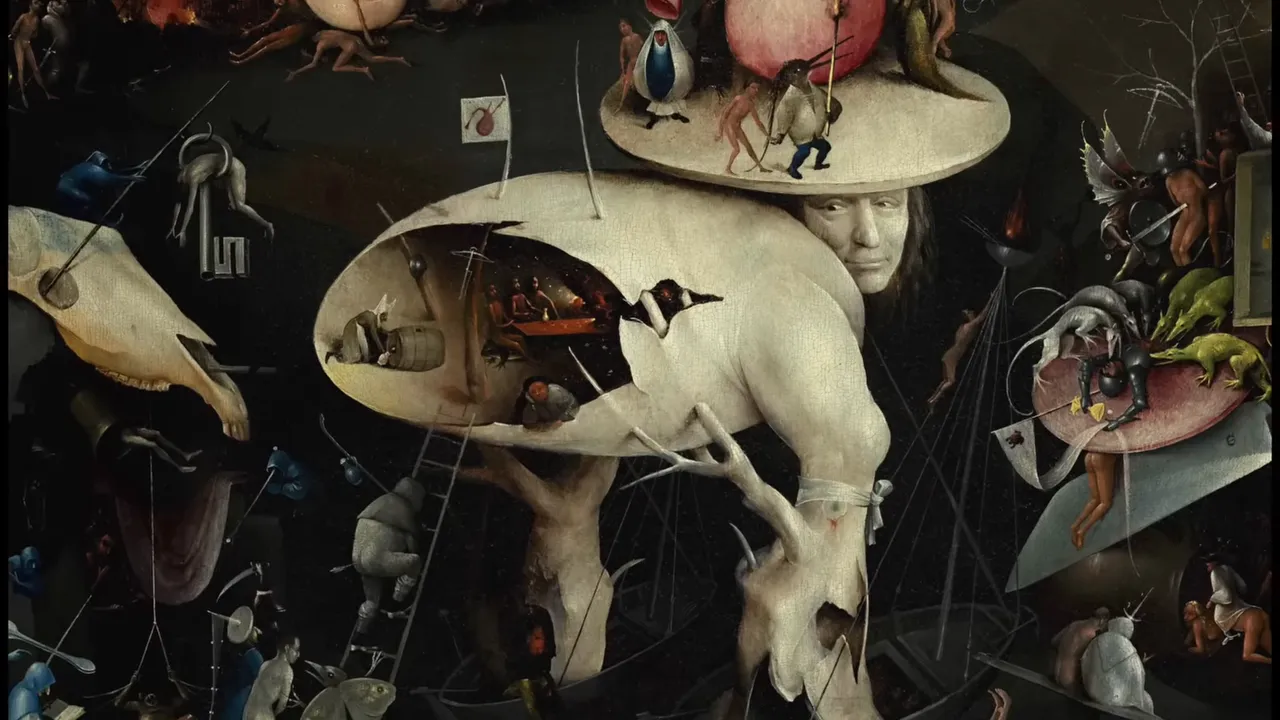
War, fire, and the memory of a burning city
In the background, cities burn. Armies move. People flee. Water offers no rescue. It is hard not to connect this with Bosch’s childhood experience of urban fire. Whatever its exact source, the scene has extraordinary force. It is not merely symbolic. It feels remembered.
Late medieval cities were vulnerable to catastrophe. Fire, war, plague, sewage, poverty, and death were never far away. Bosch’s hell gathers these earthly terrors and fuses them with eternal punishment.
At the summit of one infernal structure, two tiny figures struggle, one dark and demonic, one pale and human. It is a miniature summary of the entire painting: the battle between good and evil.
Why Bosch can look surreal but is not surrealist
Four centuries after Bosch, the Surrealists would adore him. Salvador Dalí in particular found in Bosch a predecessor of dream logic and metamorphosis. It is easy to see why.
But Bosch is not surrealist in the modern sense. His images are not the free overflow of private subconscious desire. He does not seem interested in the irrational for its own sake. His imagery is disciplined by theology, moral instruction, courtly symbolism, manuscript culture, and a serious concern with sin.
If anything, Bosch is painting what he and his culture considered real at the moral and spiritual level. In that sense, his weirdness is not escapist. It is diagnostic.
How the painting was received and why it survived
The painting became famous quickly. Many copies were made, some within Bosch’s lifetime and some by his workshop. Tapestries based on it were later produced. That tells us it was known, admired, and discussed.
After Henry III of Nassau, the work passed through inheritance and political confiscation before ending up in Spain, where it was acquired by Philip II. Philip was a rigorously Catholic monarch, defender of the faith, and a central figure in the Counter-Reformation. He collected Bosch enthusiastically.
This is one of the strongest clues against more extravagant modern interpretations. A painting held in the royal-monastic environment of Philip II, a man hardly inclined toward heretical free-love allegories, was almost certainly understood as religious and morally serious.
The work remained at El Escorial for centuries before eventually entering the Museo del Prado, where it remains one of the museum’s great masterpieces.
So what does The Garden of Earthly Delights mean?
Not every detail can be pinned down with certainty. Bosch is too inventive, too allusive, and too happy to combine traditions in ways that remain slippery. But the broad argument of the painting is clear enough.
The sequence runs like this:
- God creates the world and ordains human union
- Humanity turns fertility into lust and pleasure into obsession
- Sin multiplies, order collapses, and hell follows
This is not a painting of liberation. It is a warning. A dazzling one, an entertaining one, an intellectually playful one, but a warning all the same.
That is precisely why the work remains so powerful. Bosch does not preach through simplicity. He preaches through excess. He seduces the eye with color, beauty, wit, and novelty, then reveals the rot underneath.
If the painting still confuses and provokes, that may be because it was built to do exactly that. It withholds easy answers. It invites interpretation. It stages moral ambiguity while finally insisting on moral consequence.
And that is why five centuries later, it still feels alive.
Further context for reading Bosch
If you want to deepen your understanding of the world around Bosch, these resources are especially helpful:
- Encyclopaedia Britannica on Hieronymus Bosch
- Smarthistory on The Garden of Earthly Delights
- The Met on the Northern Renaissance
- World History Encyclopedia on Dante and infernal imagery
FAQ
Is The Garden of Earthly Delights a celebration of sex?
No. Although the central panel is full of erotic symbolism, the overall structure of the triptych suggests a moral sequence from Eden to lust to hell. The painting treats pleasure as seductive but spiritually destructive.
Was Hieronymus Bosch criticizing the Church?
Some details have been interpreted that way, but the broader evidence points to Bosch working within orthodox religious culture. He belonged to an elite Catholic confraternity and was closely connected to conservative devotional life in Den Bosch.
Why does the painting look surreal?
Because Bosch combines realistic detail with fantastical creatures, hybrid bodies, and dreamlike scenes. But unlike modern surrealism, these images are not primarily expressions of the subconscious. They are tied to moral and theological meaning.
What do the three panels represent?
The left panel shows Eden and the presentation of Eve to Adam, the center panel shows humanity surrendering to earthly pleasure, and the right panel shows hell as punishment for sin.
Who probably commissioned The Garden of Earthly Delights?
The most likely patron was Henry III of Nassau, a cultured nobleman whose court would have appreciated a complex and original allegorical painting.
Where is The Garden of Earthly Delights now?
It is in the Prado Museum in Madrid, Spain.