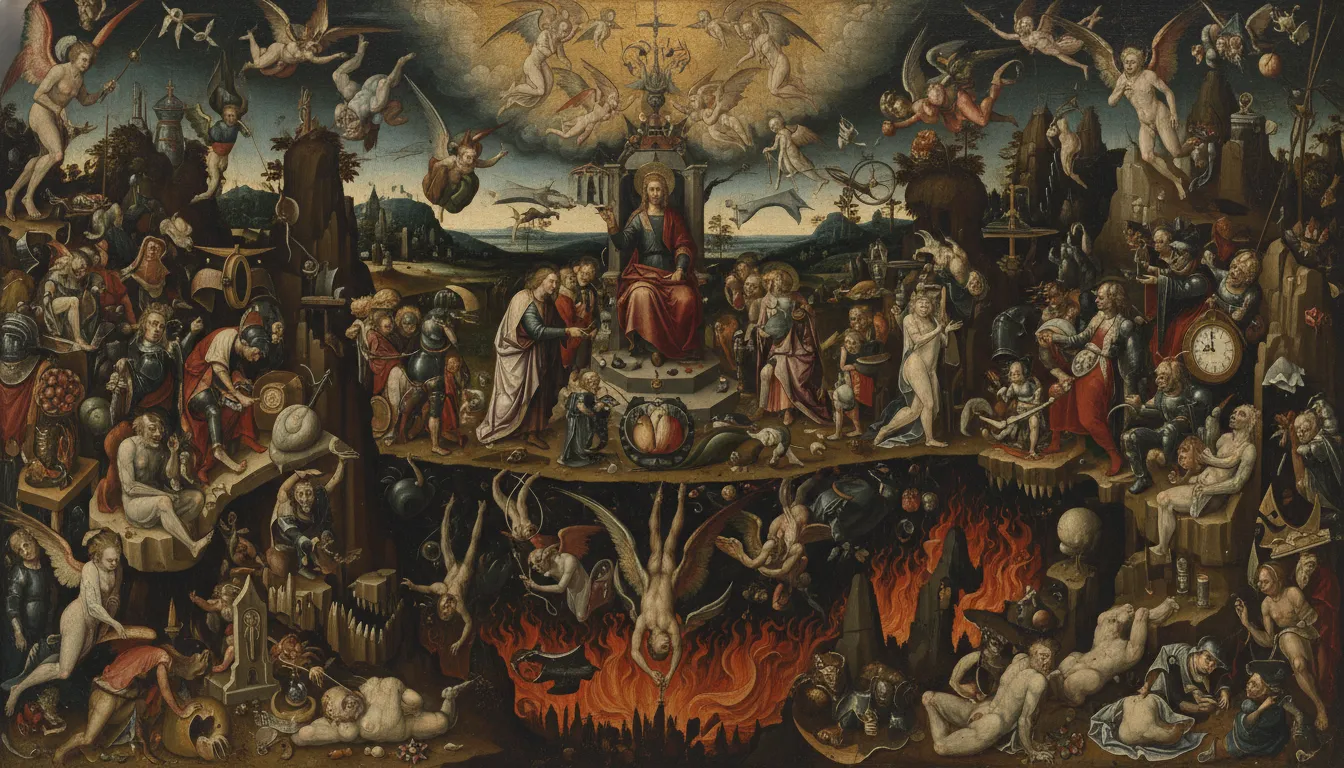
This painting once sat in the private bedroom of one of the most powerful men on earth.
King Philip II of Spain, ruler of a global empire, kept it beside his bed. Not a sweet Madonna. Not a triumphal battle scene. Not some flattering image of royal destiny. He chose instead a wooden panel crawling with sin, judgment, death, heaven, and hell.
That fact alone tells you almost everything you need to know about Hieronymus Bosch’s The Seven Deadly Sins and the Four Last Things. This is not decorative art. It is not even primarily narrative art. It is a machine of moral pressure. A warning system. A 500-year-old instrument designed to make a person examine the state of his own soul.
Painted around 1500, the work is generally thought to be oil on wood, roughly four by five feet, and many scholars believe it was intended as a tabletop rather than a wall painting. That matters. A tabletop is intimate. You do not merely pass by it. You confront it. You sit with it. You return to it. It lives in your space like a silent accusation.
Today the painting is in the Museo del Prado in Madrid, where it remains one of the most unsettling religious images ever made. Bosch, that great architect of spiritual nightmare, built the entire composition around one devastating idea: God sees everything.
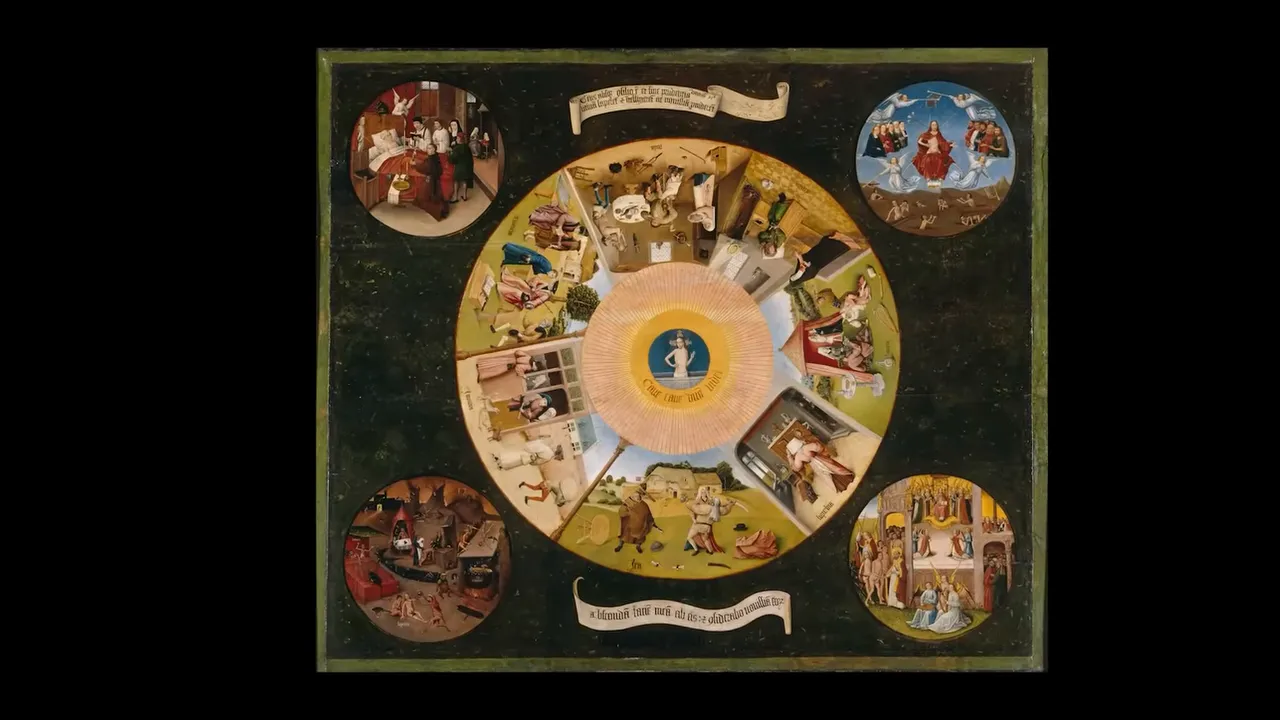
Table of Contents
- The Eye at the Center
- A Cosmic Diagram of Human Failure
- Wrath: The Fool’s Battle
- Envy: Wanting What Is Not Yours
- Greed: When Justice Is for Sale
- Gluttony: A House Where the Soul Has Starved
- Sloth: The Sleep of the Soul
- Lust: The Theater of Seduction
- Pride: The First Sin Returns
- The Four Last Things
- Why Philip II Kept It Beside His Bed
- Why the Painting Still Feels So Unsettling
- Bosch’s Moral Genius
- FAQ
The Eye at the Center
The structure of the painting is brilliantly simple and psychologically ruthless.
At the center is a great circular field divided into scenes of the seven deadly sins. In the middle of that circle is a smaller one showing Christ emerging from the tomb, displaying the wounds of the Crucifixion. This central image forms the pupil of what is often described as the Eye of God.
The symbolism is not subtle. Bosch did not want subtlety here. He wanted the force of a moral hammer blow.
Beneath Christ appears the inscription:
Cave, cave, Deus videt.
Beware, beware, the Lord sees.
That sentence changes the entire experience of the painting. The scenes around the center are not merely illustrations of bad behavior. They are episodes unfolding under divine surveillance. Nothing is private. Nothing is hidden. Every petty indulgence, every compromise, every degradation is known.
Above and below the central eye are scrolls with lines from Deuteronomy. The upper one condemns humanity as a people lacking understanding. The lower one delivers the real sting: if only they were wise enough to consider their latter end.
That phrase, their latter end, is the key to everything Bosch is doing. He is not interested in sin as social gossip. He is interested in consequences. Where does each appetite lead? What becomes of a life given over to vice? What happens when temporary pleasure hardens into eternal condition?
A Cosmic Diagram of Human Failure
The seven deadly sins in Bosch’s painting are arranged like spokes around the eye. Starting at the bottom and moving clockwise, they form a full moral anatomy of fallen human nature:
- Wrath
- Envy
- Greed
- Gluttony
- Sloth
- Lust
- Pride
What makes Bosch extraordinary is that he does not depict these sins as abstractions. He renders them as tiny lived dramas. They are vulgar, domestic, comic, ugly, recognizable. That is why they still sting. These are not mythic monsters from some unreachable symbolic realm. These are human beings making very human choices.
Wrath: The Fool’s Battle
Bosch begins at ground level, in the gutter.
Wrath is set in what appears to be a country brothel or tavern. Two drunken men are fighting. One reaches clumsily for his sword. A woman restrains him, grabbing at both his belt and the weapon, as if her single body is the last thing standing between this stupid brawl and murder.
The other man wears a chair on his head like a ridiculous helmet. It is one of those classic Bosch details that is both funny and devastating. Anger strips a person of dignity. It does not ennoble. It degrades. It turns a man into an absurdity.
An overturned table lies nearby, a small but telling sign of how quickly order collapses. The scene is chaotic, but not grandly chaotic. Bosch understands that rage is usually pathetic before it is tragic.
And then comes the contrast that gives the scene its full force. Beyond the brawl stretches a serene Flemish landscape. Calm water. Rolling hills. A quiet town. Peace is right there. The world beyond the quarrel remains beautiful and undisturbed.
That contrast is the whole theology of wrath in miniature. Anger is not simply violence against another person. It is a chosen blindness to the good still present in the world.
Envy: Wanting What Is Not Yours
Envy is one of Bosch’s most elegantly constructed scenes because it unfolds through glances.
An old couple stand in a doorway, their attention fixed on a wealthy young nobleman in fine clothing. The old man seems to desire the nobleman’s wealth and status. But the nobleman is not looking at them. His gaze shifts toward a young couple, where a simple suitor offers a flower through the window to the old man’s daughter.
There is the sting. The nobleman has money, dress, rank, and probably the expectation of success. Yet what he cannot command is genuine affection. The young woman looks not at status, but at the man offering her a flower. The nobleman, for all his worldly advantages, is left outside the real exchange.
Then Bosch adds a cutting detail: a man walks away carrying a heavy bag, likely the returned dowry. The transaction has failed. Wealth has been refused.
Beneath the human drama, dogs bark and snarl over bones scattered on the ground. This evokes a Flemish proverb Bosch’s audience would have recognized: two dogs and one bone, no agreement. The animals mirror the humans. The old man envies wealth. The nobleman envies love. The dogs envy out of instinct.
Envy, Bosch suggests, is a distortion of sight. It keeps attention fixed on what another person has while making one blind to what already lies at one’s own feet.
Greed: When Justice Is for Sale
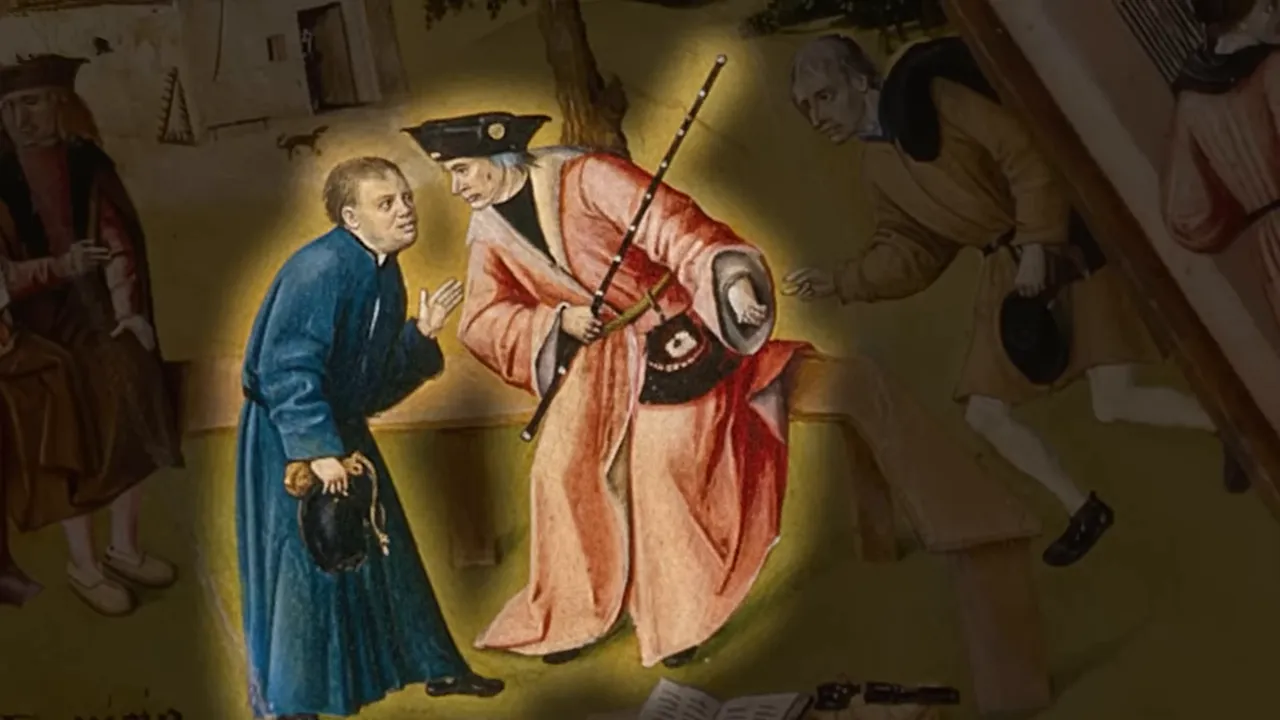
Greed appears not in a counting room but in a courtroom, which makes the scene far more disturbing.
A magistrate sits with the symbols of legal authority, hearing a case. One hand appears attentive, as though weighing the plea of the man before him. But the other hand is extended to receive a bribe. Another figure quietly places money into that open palm.
This is not greed in isolation. This is greed infecting institutions. Bosch is showing corruption where it does the most damage, at the point where society claims to uphold fairness.
Even more chilling are the officials beside the judge who do nothing. They see the exchange and remain silent. Bosch understands that evil rarely survives on the sinner alone. It flourishes through passivity, through systems, through the willingness of others to let the rot continue.
Again, the background matters. A beautiful landscape surrounds the scene. Natural order remains intact while human beings deform the structures they themselves have built. The implication is brutal. Creation is good. It is humanity that contaminates its own house.
Gluttony: A House Where the Soul Has Starved
Gluttony in Bosch’s hands is not festive. It is miserable.
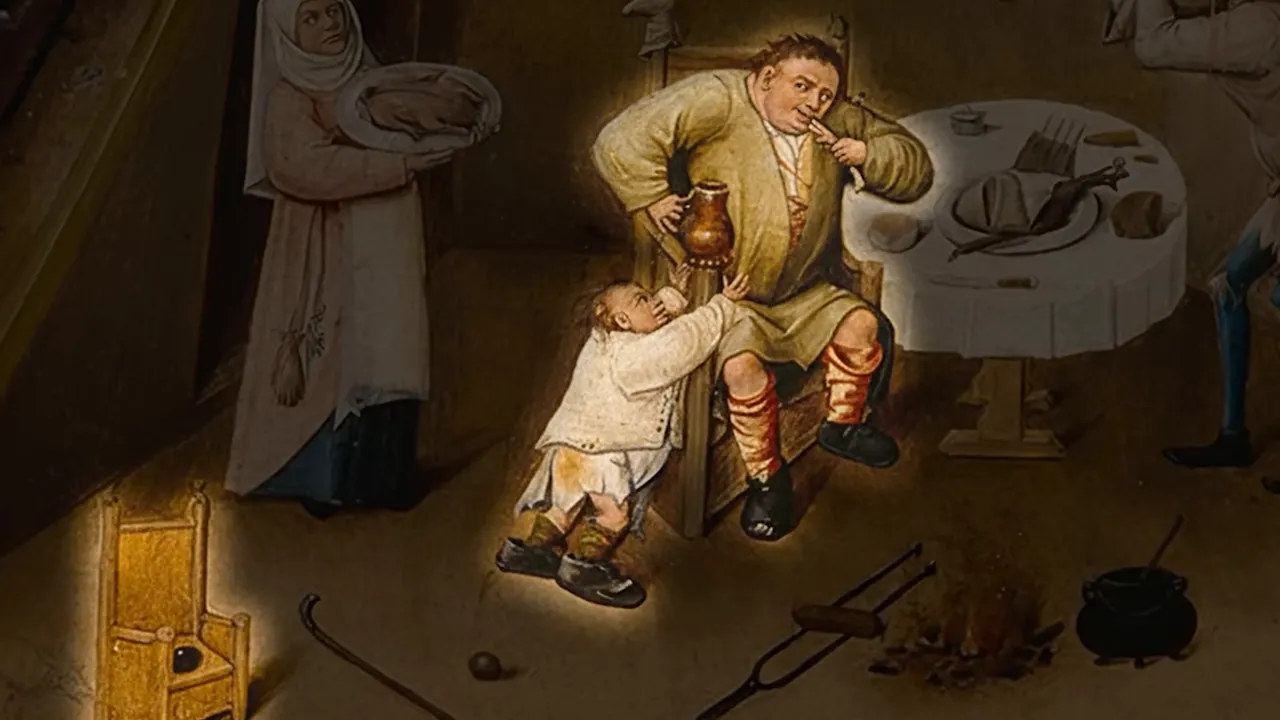
A peasant family sits in a cramped, filthy domestic space. At the center is a grotesquely swollen man, fused to the table by appetite. He grips a gnawed bone. His eyes look empty, almost animal, consumed by the act of consuming.
Then Bosch introduces the detail that makes the whole scene unforgettable: in the foreground is a child’s potty chair. The child, bloated like the father, is dirty and neglected, reaching not for food but for care. The father ignores him completely.
That is Bosch’s true target. Gluttony is not merely overeating. It is the reduction of life to appetite. Everything else gets abandoned: cleanliness, love, attention, responsibility, dignity.
There is also another man nearby drinking from a jug, a ragged figure dissolving himself into oblivion. One gorges on food, the other on drink. Two versions of the same hunger. Neither is nourishment. Both are collapse.
The wife enters carrying more food, her expression hard with resentment. She is not portrayed as joyful provider but as part of the machinery of mutual degradation. In this home, appetite rules and everyone else serves it.
This is one of Bosch’s harshest insights. The more the body is treated as the answer to spiritual emptiness, the more desolate the household becomes.
Sloth: The Sleep of the Soul
Sloth may be the quietest panel, but it is one of the most severe.
A man dozes in a chair by the fire, comfortably bundled in warmth. On the surface it seems harmless. No violence. No vulgarity. No open corruption. But Bosch is not interested in ordinary rest. He is painting neglect.
A closed book lies nearby, likely a devotional text. A rosary and an apparition of faith herself make clear what is being abandoned. This man is not merely tired. He is absent from his spiritual life. He has chosen comfort over prayer, passivity over discipline, drifting over devotion.
At his feet, a dog sleeps too. That parallel is vicious. The human being, endowed with reason and soul, has settled into the same unconscious state as the animal beside him.
Sloth here is not simple laziness. It is the refusal to become what one is called to become. Bosch treats it as a spiritual surrender, a quiet collapsing inward while the fire of grace goes untended.
Lust: The Theater of Seduction
For lust, Bosch stages not an intimate encounter but a performance.
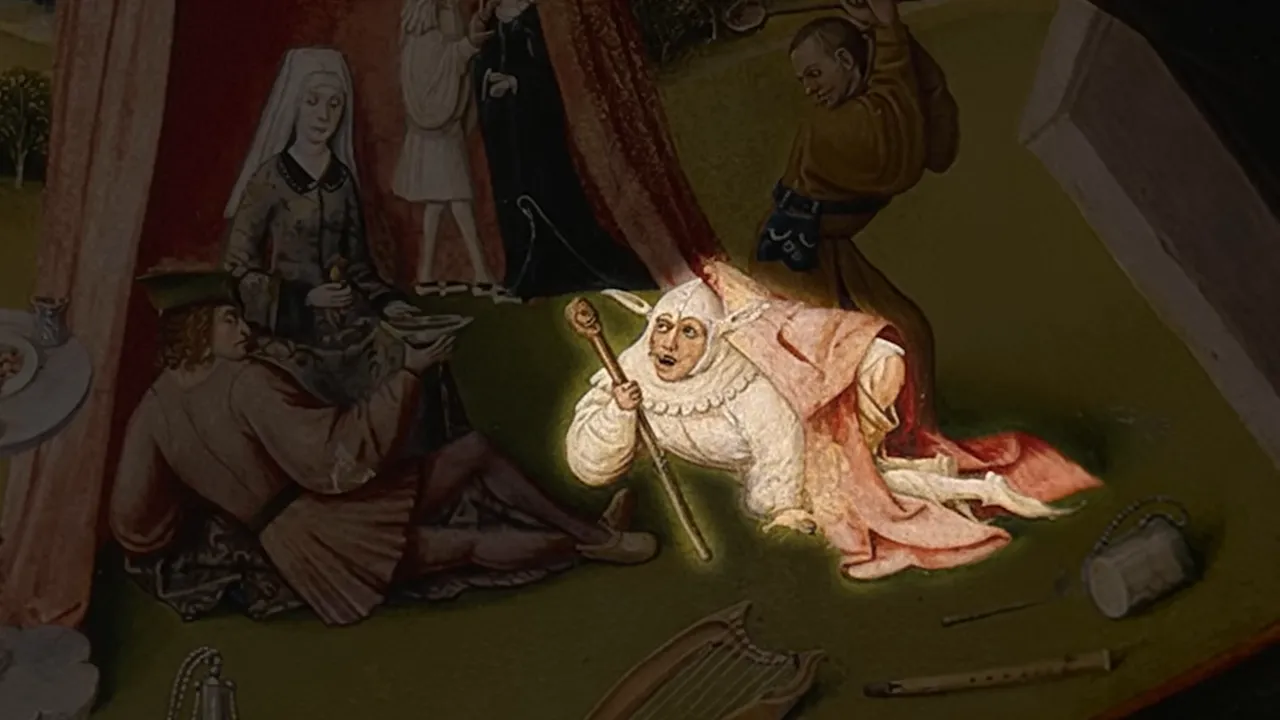
Elegant couples gather beneath a tent. A jester contorts himself in a lewd pose. Another man handles a large spoon, a familiar emblem in Bosch’s time for illicit erotic love. Musical instruments lie abandoned on the ground.
Every element signals that the movement from flirtation to sexual transgression has already occurred. Bosch draws on a proverb linking music to love-making. The instruments have done their work. They are now discarded because seduction no longer needs disguise.
The genius of the panel is that lust is shown as spectacle. It is orchestrated, staged, encouraged by props, atmosphere, and social play. It is not only the desire between two people. It is the entire culture of amusement built to inflame desire while pretending innocence.
The fool is especially important. In late medieval symbolism, the fool often represented moral recklessness, appetite ungoverned by wisdom. Here he embodies the obscene truth everyone else wishes to veil in elegance.
Lust, in Bosch’s vision, is not romantic freedom. It is the conversion of desire into farce.
Pride: The First Sin Returns
Bosch saves pride for last because in Christian thought it is the root from which the others grow.
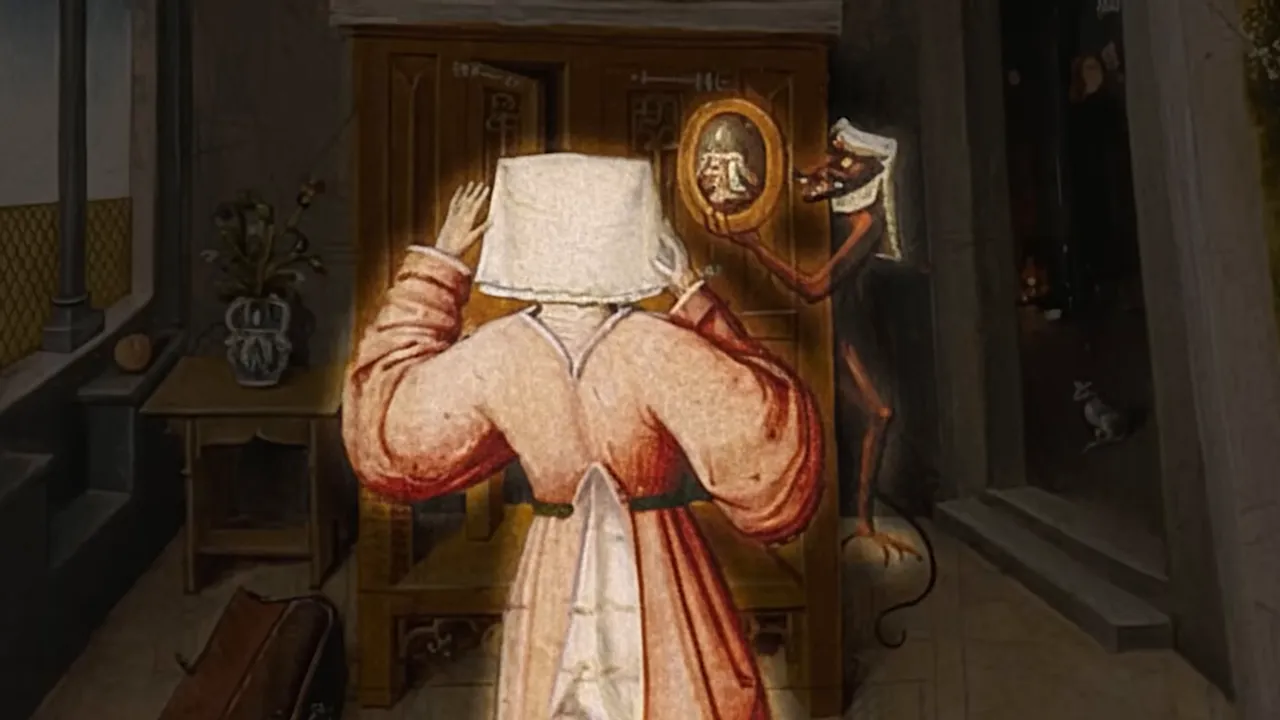
A wealthy woman stands in a luxurious chamber admiring herself in a mirror. At first the scene appears almost ordinary, a warning against vanity. Then Bosch reveals the deeper horror: the mirror is held not by a maid, but by a demon.
This is one of the most chilling images in the entire painting. Pride is self-deception aided by hell. The demon does not show her truth. It reflects back a curated illusion, the image she wishes to believe.
The demon even mirrors her fashion, grotesquely parodying her vanity. Nearby lie jewels, expensive vessels, and cut flowers already dying in their vase. On the windowsill sits an apple, unmistakably recalling the Fall.
That apple matters. Bosch is linking this woman not just to vanity but to the original rupture in Eden, where the desire to exalt the self over obedience shattered paradise.
Pride is more than arrogance or self-love. It is a severing from reality. It convinces a person that glory originates in the self, even while corruption stands inches away, holding the mirror.
The Four Last Things
In the corners of the painting are four circular scenes known in medieval Christian teaching as the Four Last Things:
- Death
- Judgment
- Heaven
- Hell
These are not side notes. They provide the framework that gives the seven sins their full meaning. Bosch is not interested in vice as bad habit alone. He is placing sin in an eschatological universe. Human actions are moving toward an end.
Death: The Final Battle
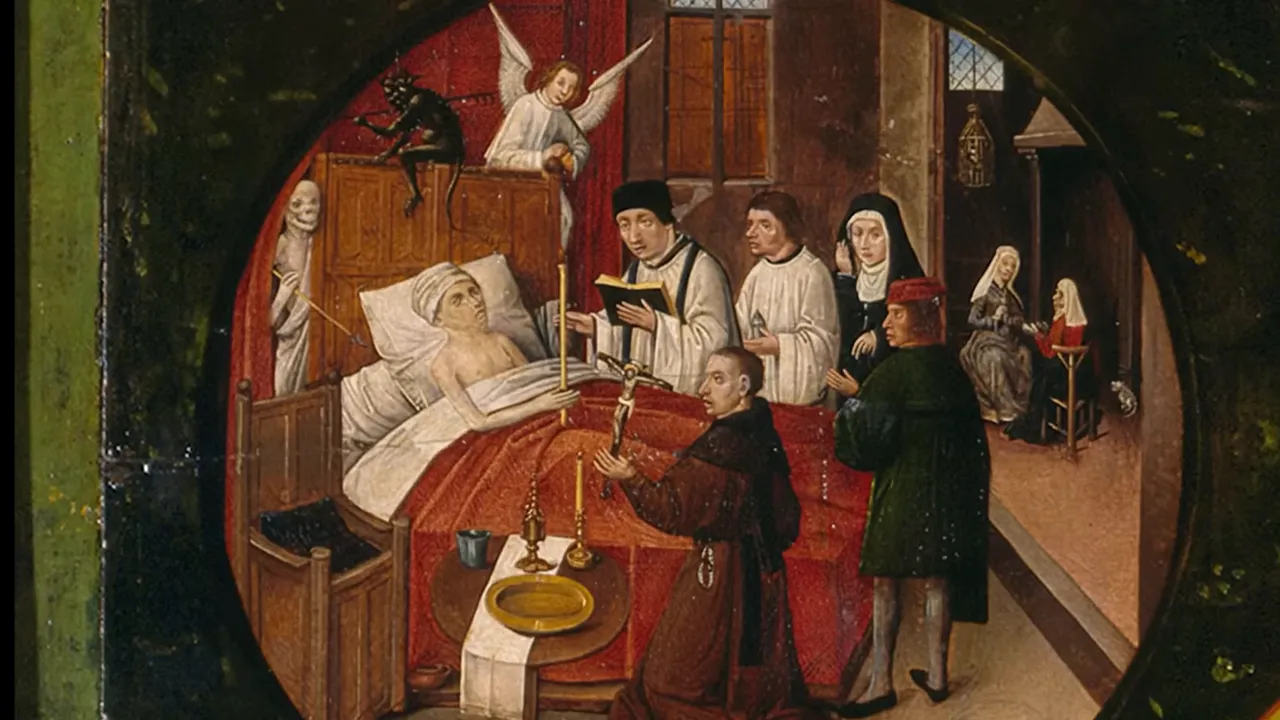
In the death scene, a man lies in bed surrounded by clerics and spiritual attendants, but the real contest unfolds on another level. An angel calls him upward. A devil leans in from the other side. A skeleton, death itself, points an arrow at his heart.
This is the medieval Ars Moriendi, the art of dying. Death was not imagined as passive fading away. It was a final, conscious struggle in which the soul might yet turn toward grace or cling to the sins of a lifetime.
The image closely recalls themes Bosch explored elsewhere, especially in Death and the Miser, where money and crucifix compete for the dying man’s allegiance. The spiritual tension is the same. Even at the threshold of death, attachment to worldly things remains powerful.
In a culture shaped by plague, instability, and intense religious instruction, this scene would have struck directly at the fears of the age. Death is immediate. The soul is contested. The final moment matters.
Judgment: The Universe Opens
In the panel of the Last Judgment, Christ appears as divine judge seated upon a rainbow. Around him gather saints and witnesses. Below, the dead rise from the earth to face their reckoning.
This is where every scene in the central circle was always heading. Wrath, envy, greed, gluttony, sloth, lust, pride. Nothing remains concealed. Every deed becomes subject to final evaluation.
The image belongs to a long medieval tradition visible across cathedral sculpture and manuscript illumination, but Bosch compresses it into a direct moral endpoint. The point is not speculative theology. It is urgency. Human life is not random movement. It is accountable movement.
Heaven: The Reward of Right Orientation
The heavenly panel offers relief after so much corruption and dread. Angels make music. The saved approach the gates. Saint Peter receives them. Christ appears no longer primarily as judge but as ruler in peace and blessing.
Even here, Bosch includes one final remnant of struggle. The Archangel Michael protects a woman from a clawing devil at the threshold. Evil is being left behind at the very instant of salvation.
The heavenly city is rendered in a Gothic style familiar to Bosch’s world. That familiarity matters. Heaven is not painted as alien fantasy but as the perfected form of sacred architecture already known in earthly worship. The church below reflects the Jerusalem above.
After all the terror, Bosch does not omit the promise. The painting is meant to warn, yes, but warning only has force when an alternative remains possible.
Hell: The Sin Becomes the Punishment
Then Bosch descends into the furnace.
Hell is where the painting’s logic becomes complete. The punishments are not random. They are the sins themselves reflected back, intensified, and made eternal.
Each vice receives its own fitting torment:
- The wrathful are hacked apart by violence.
- The envious are set upon by dogs.
- The greedy are immersed in molten gold and filth.
- The glutton is force-fed grotesque creatures.
- The slothful are beaten in a mockery of neglected religious life.
- The lustful are trapped together in monstrous intimacy.
- The proud are degraded by the symbols of their own vanity.
One detail stands out with particular cruelty. The proud woman who once admired herself in a mirror is now confronted with bodily humiliation and corruption. Pride, which imagined transcendence, ends in degradation. Bosch insists that the inner sin was always deforming the outer person.
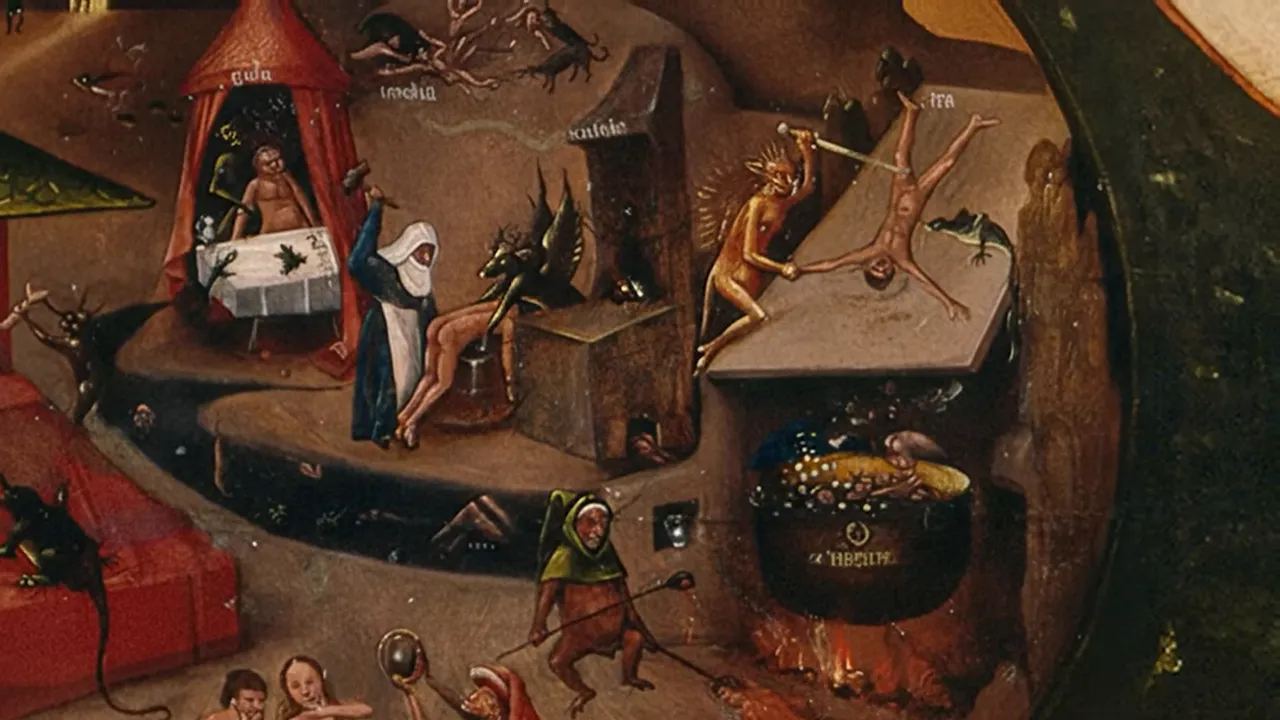
This is Bosch’s most terrifying theological claim: hell is not merely a place where punishment happens. It is a state in which chosen sin becomes one’s environment.
Why Philip II Kept It Beside His Bed
That strange historical detail now makes perfect sense.
Philip II did not keep this object near him because it was charming or even because it was merely prestigious. He kept it because it functioned as a spiritual instrument. A daily examination. A memento mori. A map of possible endings.
The painting presents four destinations for the soul: death, judgment, heaven, hell. Around the center eye, the seven deadly sins display the ordinary ways a person wanders toward destruction. Seen this way, the work becomes almost diagnostic. It asks, relentlessly: where are you in this wheel?
That is why a tabletop format is so powerful. It belongs to daily life. Meals, decisions, conversations, private thoughts. Bosch inserts eternity directly into the furniture of ordinary existence.
Why the Painting Still Feels So Unsettling
The painting is over five centuries old. Its late medieval Catholic worldview is historically specific. Its symbols are rooted in a world of sermons, proverbs, devotional habits, plague anxiety, and vivid belief in damnation.
And yet it still feels unnervingly alive.
Part of that is Bosch’s visual imagination, which remains bizarre enough to resist becoming tame. But the deeper reason is that he understood something ugly and permanent about human beings: most moral failure does not look grand. It looks petty, comic, domestic, repetitive, and self-justifying.
Wrath is a drunken idiot with a chair on his head.
Envy is the rich man wanting what cannot be purchased.
Greed is a judge taking one small coin.
Gluttony is a family forgetting how to care for each other.
Sloth is a man choosing comfort over attention.
Lust is entertainment curdled into appetite.
Pride is a person staring into a false mirror and loving the lie.
That is why Bosch still lands. He does not flatter. He does not romanticize sin. He strips it of glamour and shows its mechanics.
Bosch’s Moral Genius
Hieronymus Bosch remains one of the most enigmatic painters in art history, but in this work his intent feels piercingly clear. He is not simply inventing monsters for the pleasure of invention. He is creating moral psychology in paint.
The central eye organizes the entire work around divine knowledge. The sins reveal how people actually fall. The corner panels show where such lives end. Every part of the design reinforces every other part. It is systematic, didactic, theatrical, and deeply imaginative all at once.
For more context on Bosch’s life and works, the Encyclopaedia Britannica entry on Hieronymus Bosch and the Google Arts & Culture overview provide useful background. If the broader tradition of medieval death spirituality is of interest, the Metropolitan Museum of Art’s essay on the Ars Moriendi offers helpful context for the deathbed imagery Bosch used so powerfully.
But even without scholarly framing, the message of this painting remains immediate. Beware. The Lord sees. Consider your latter end.
The king is gone. Bosch is gone. The world that produced this table is gone.
The eye is still open.
FAQ
What is The Seven Deadly Sins and the Four Last Things by Hieronymus Bosch?
It is a late 15th or early 16th century painting attributed to Hieronymus Bosch that depicts the seven deadly sins in a central circular composition, with the Four Last Things in the corners: Death, Judgment, Heaven, and Hell. The work is structured as a moral warning about sin and eternal consequences.
Why is the painting called the Eye of God?
The central composition resembles an eye. Christ appears in the middle like the pupil, surrounded by scenes of human sin. The design reinforces the idea that God sees everything. The Latin inscription beneath the center makes this explicit: Cave, cave, Deus videt, or “Beware, beware, the Lord sees.”
Was this painting really used as a tabletop?
Researchers have argued that it was likely intended as a tabletop rather than a wall painting. That would fit its function as an object for close contemplation during everyday life, making its moral message even more intimate and inescapable.
Why did King Philip II of Spain keep Bosch’s painting near his bed?
It appears to have served as a spiritual and moral reminder. Rather than treating it as decoration, Philip II likely valued it as a work of religious reflection, a daily prompt to examine sin, judgment, death, salvation, and damnation.
What are the seven deadly sins shown in Bosch’s painting?
The painting shows wrath, envy, greed, gluttony, sloth, lust, and pride. Bosch presents each one as a miniature human drama rather than an abstract symbol, making the sins feel immediate and recognizable.
What are the Four Last Things in medieval Christian art?
The Four Last Things are Death, Judgment, Heaven, and Hell. In medieval spirituality, they represented the ultimate destiny of every soul and were used in preaching and devotional teaching to encourage repentance and moral seriousness.
What makes Bosch’s hell scene so disturbing?
Its punishments are tailored to the sins themselves. Bosch suggests that hell is not arbitrary torture but the sinner’s own vice returned in grotesque and eternal form. That logic makes the scene psychologically and spiritually terrifying.
Where is the painting today?
The painting is in the Prado Museum in Madrid, where it remains one of Bosch’s most famous and disturbing works.